Productivity●Mid
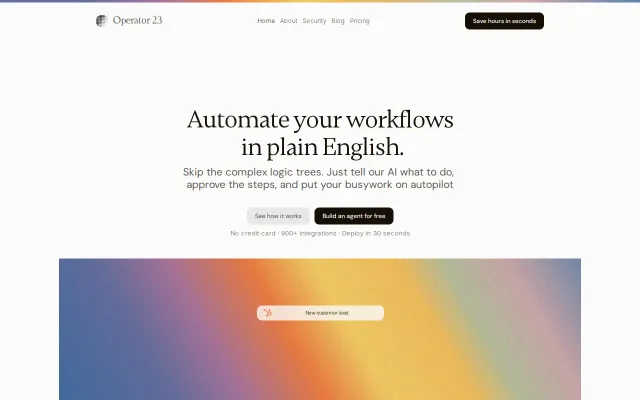
Automate your workflow in plain English
Yet another Zapier alternative where plain English replaces flowchart builders.
Ship It
Mrakermo
1272mo ago
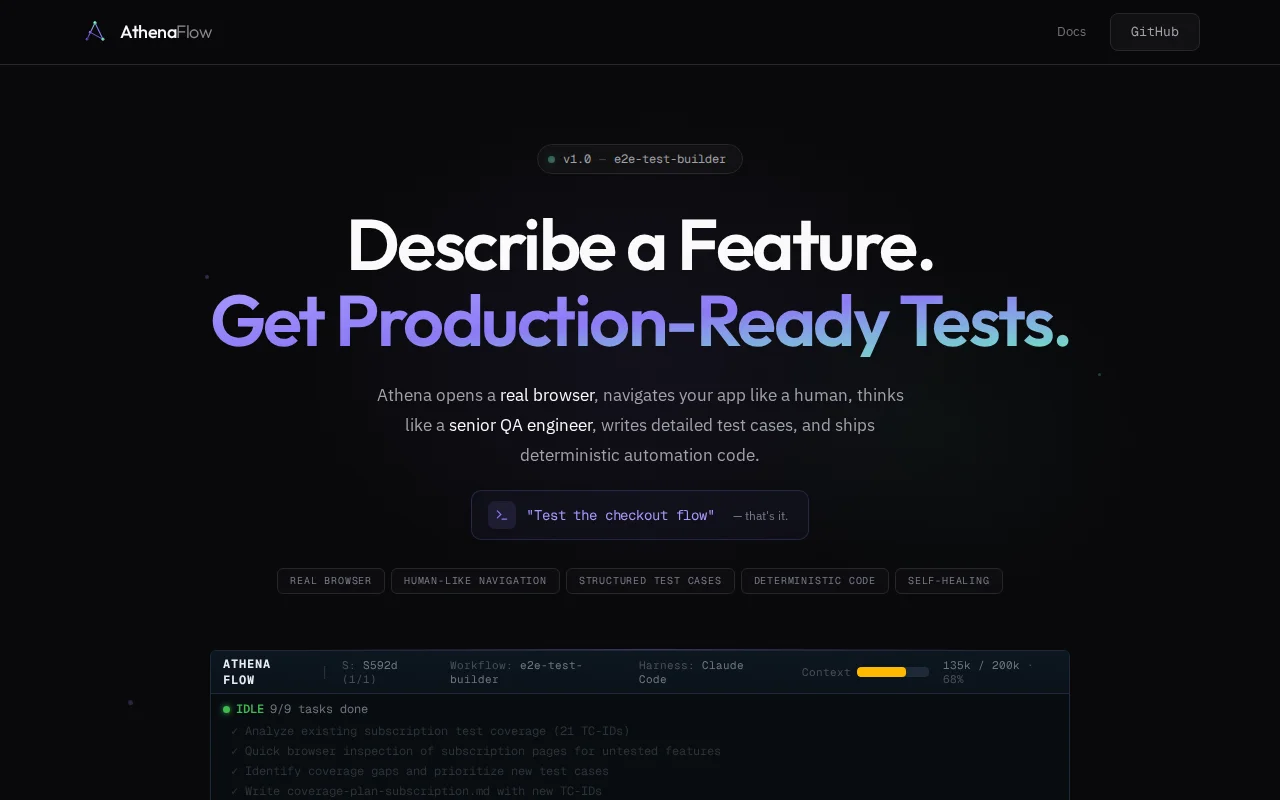
E2E test builder using Claude Code with semantic browser snapshots, but execution depends on Claude's availability.
QA engineers and developers automating test suite creation and maintenance
Playwright Inspector · GitHub Copilot for Tests · Mabl
Instead of writing throwaway prompts or one-off scripts to automate complex multi-step tasks, you define a workflow once — with prompt templates, loops, plugin bundles, and structured lifecycle hooks — and run it against any project.
The first workflow I shipped is e2e-test-builder. It navigates your app like a human, writes structured test case specs with preconditions, steps, and expected outcomes, then generates Playwright code from them. The browser layer is handled by a separate MCP server I built called agent-web-interface, which produces semantic page snapshots instead of raw DOM — ~19% fewer tokens and ~33% faster task completion in early benchmarks against Playwright MCP.
The stack is three repos: athena-flow is the runtime (hooks -> UDS -> event pipeline -> TUI), agent-web-interface is the MCP server for token-efficient browser interaction, and athena-workflow-marketplace is where workflows and plugins live, resolved by ref like e2e-test-builder@lespaceman/athena-workflow-marketplace.
Workflows are composable — a workflow bundles plugins and can be shared via any Git repo. Writing your own is just a workflow.json and a prompt file.
Currently Claude Code only, but Codex support is in progress. Free if you already have a Claude Code subscription, no separate API key needed. MIT licensed.
Docs: https://athenaflow.in GitHub: https://github.com/lespaceman/athena-flow
Would love feedback, especially from anyone building on Claude Code hooks or thinking about workflow portability across agent runtimes.
Yet another Zapier alternative where plain English replaces flowchart builders.
Runtime-owned state with recovery rules for agent workflows that outlive a single session.
Useful shell script patterns, but just a workaround for API rate limits.
LLM-driven desktop automation from screenshots, but unreliable and dangerous.
Context clearing between steps cuts costs, but hallucinated 2026 citations hurt trust.
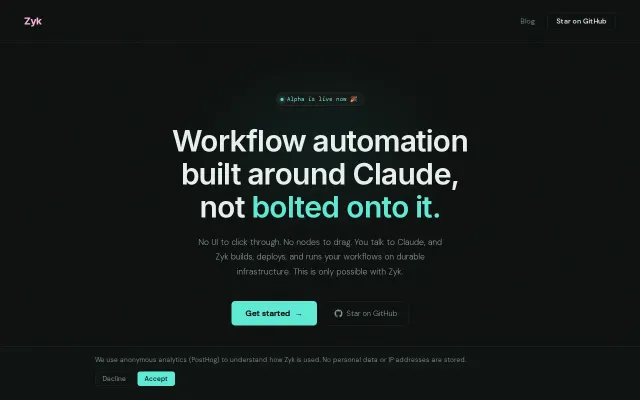
Durable workflows built by chatting with Claude instead of dragging nodes in n8n.