AI/ML●●●Banger
EdgeRunner – run GGUF models with Swift and Metal
Pure Swift inference engine beats llama.cpp without any C++ bindings.
WizardryZero to One
karc14
2014d ago
Golang inference engine and deep learning primitives
Pure Go LLM inference, zero dependencies, 48 tok/s—genuinely novel for Go ecosystem.
Go developers needing local LLM inference without Python/C++ dependencies
llama.cpp · Ollama · tinygrad
I built this because I wanted to add local LLM inference to a Go project without shelling out to Python or linking against llama.cpp. The whole thing is go get github.com/computerex/dlgo and you're running models.
It supports LLaMA, Qwen 2/3/3.5, Gemma 2/3, Phi-2/4, SmolLM2, Mistral, and Whisper speech-to-text. Architectures are expressed as a declarative per-layer spec resolved at load time, so adding a new model family is mostly just describing its layer structure rather than writing a new forward pass.
Performance on a single CPU thread with Q4_K_M quantization: ~31 tok/s for LLaMA 3.2 1B, ~48 tok/s for Qwen3 0.6B, ~16 tok/s for Qwen3.5 2B (which has a hybrid attention + Gated Delta Network architecture). Not going to beat llama.cpp on raw speed, but it's fast enough to be useful and the ergonomics of a native Go library are hard to beat.
Supports 25+ GGML quantization formats (Q4_0 through Q8_0, all K-quants, I-quants, F16, BF16, F32). The GGUF parser, dequantization, tokenizer, forward pass, and sampling are all implemented from scratch.
Pure Swift inference engine beats llama.cpp without any C++ bindings.
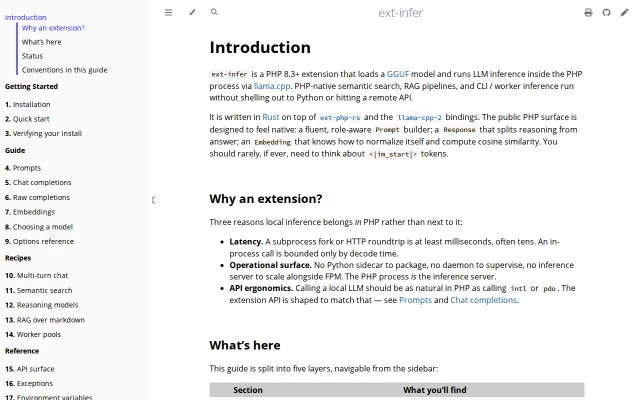
In-process LLM inference in PHP beats the usual Python sidecar pattern.
30x faster cold start than vLLM with zero PyTorch dependencies.
Custom GGUF parser with mmap beats llama.cpp load times, but zero stars means unproven claims.
Pure C++23 Metal inference when llama.cpp already dominates this space.
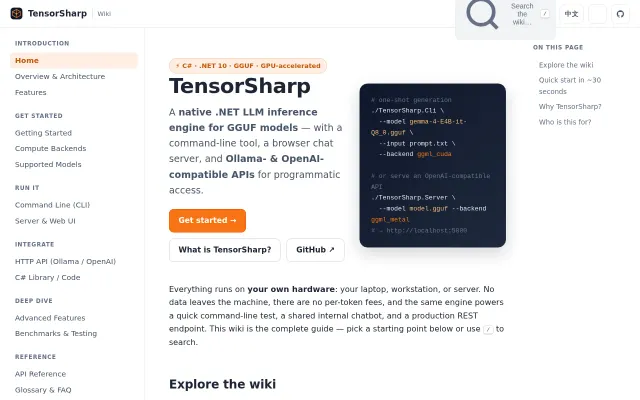
Native .NET LLM inference when everything else forces you into Python.