Open Source●●●●Gem
BXP – An open standard for atmospheric exposure data
HTTP-equivalent standard for air quality data, federated networks, no licensing or hardware lock-in.
Zero to OneBig BrainSolve My Problem
BXP
103mo ago
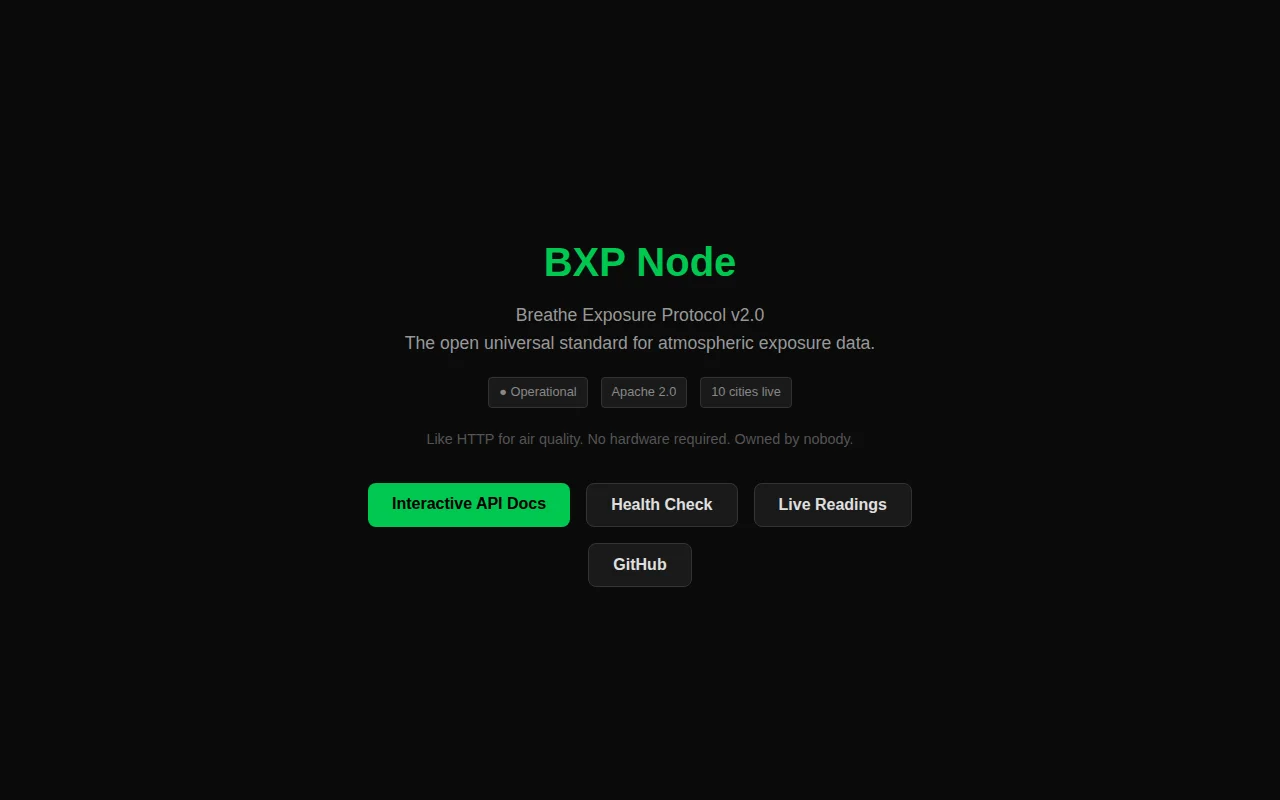
HTTP-for-air-quality: open standard with WHO-weighted health index, no licensing, 10 cities live.
Climate researchers, air quality agencies, public health officials, sensor manufacturers
Every device, app, and agency stores air quality data in incompatible formats. A sensor in Accra cannot speak to a hospital in Nairobi. A researcher in London cannot access ground-truth data from Lagos. There is no open standard for atmospheric exposure data — the same way there was no open standard for the web before HTTP.
BXP (Breathe Exposure Protocol) is my attempt to fix that.
It defines: — A universal .bxp file format any device or software can read and write — BXP_HRI: a composite Health Risk Index incorporating all agents with WHO-derived weighting — A complete REST API specification for federated node networks — A privacy framework protecting individual exposure records by design
Like HTTP, PDF, or MP3 — BXP is a format layer. No hardware required. No licensing fees. No central owner. Apache 2.0. Forever free.
The reference implementation is live right now:
Live public node: https://bxp-node.onrender.com GitHub + full source: https://github.com/bxpprotocol/bxp-spec Spec DOI (Zenodo): https://doi.org/10.5281/zenodo.18906812 Implementation DOI: https://doi.org/10.5281/zenodo.18907003
You can clone it and run your own BXP node in under 3 minutes:git clone https://github.com/bxpprotocol/bxp-spec cd bxp-spec/reference-server pip install fastapi uvicorn pydantic python server.py
The spec covers 31 atmospheric agents — PM2.5, NO2, ozone, benzene, mold, heavy metals — with WHO thresholds, quality flags, geohash-based spatial indexing, and a federated network architecture where each node operator owns their own data completely.I am looking for developers, researchers, and institutions who want to implement BXP, contribute to the spec, or run a community node. Particularly interested in connecting with anyone working on air quality infrastructure in developing countries where the data gap is most severe.
Happy to answer any questions.
HTTP-equivalent standard for air quality data, federated networks, no licensing or hardware lock-in.
Math-heavy claims without credible evidence of 500K-node stress test.
Ed25519 keys as channel identities finally decouple broadcast identity from hosting infrastructure.
Directory-level differential sync that rsync and xdelta never solved for cloud storage.
P2P mesh networking for AI agents removes the central orchestrator bottleneck entirely.
Archived repo with zero stars and README that's just Wikipedia links about hypertext.