Education●Mid
A simulated computer on Mars with real orbital mechanics
Educational Mars sim, but page content doesn't match the project title.
Niche Gem
kilroy123
412mo ago
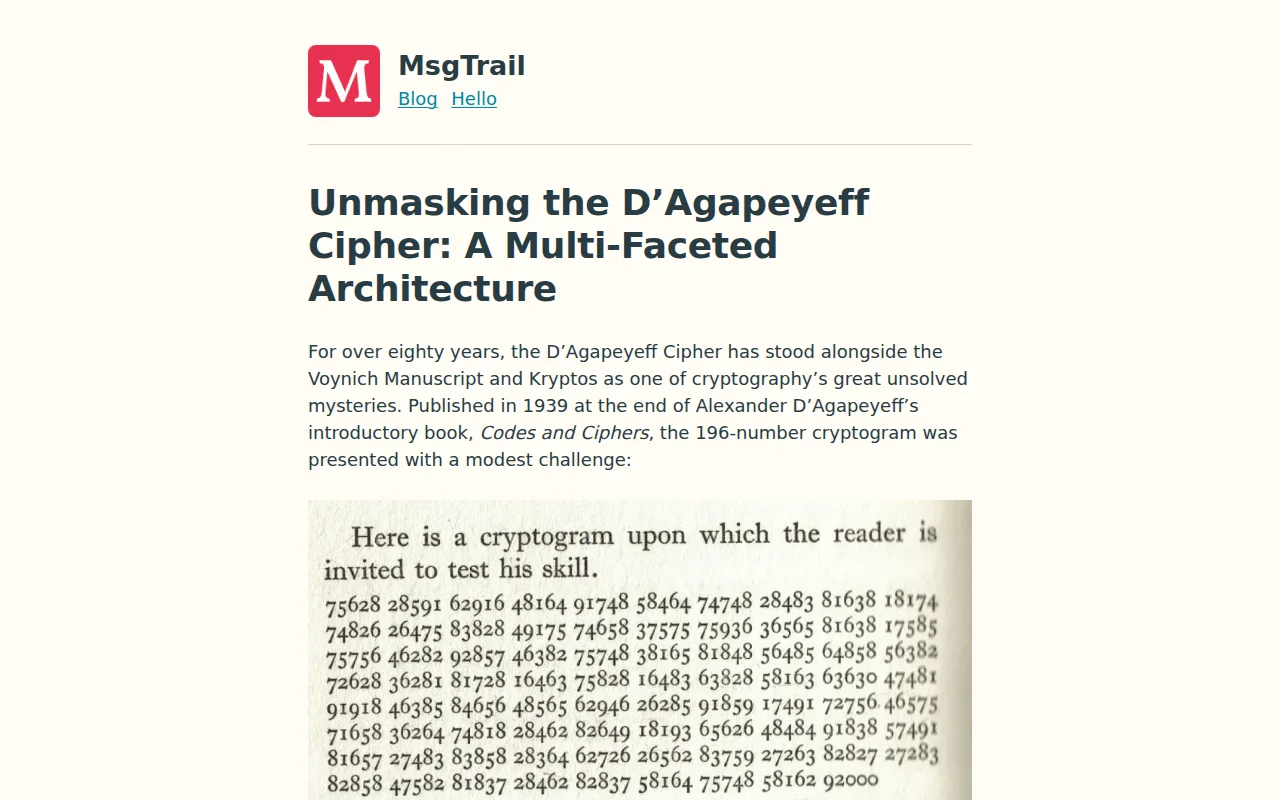
Esperanto quadgrams outscores English by 200+ points on this 85-year-old unsolved cipher.
Cryptography enthusiasts, security researchers, puzzle solvers
Cryptii · dCode · Boxentriq
1. All 5 anomalous symbol values in the cipher cluster in the last column of a 14x14 grid. This turns out to be driven by a factor-of-2-and-7 positional pattern in the linear text.
2. Simulated annealing with Esperanto quadgrams (23M char Leipzig corpus) on a 2x98 columnar transposition consistently outscores English by 200+ points and recovers the same Esperanto vocabulary across independent runs.
The cipher is not solved. But the combination of structural geometry and computational linguistics narrows the search space significantly.
Work in progress, more to come!
Educational Mars sim, but page content doesn't match the project title.
Meshless Voronoi discretization running realtime on Vulkan is genuinely clever.
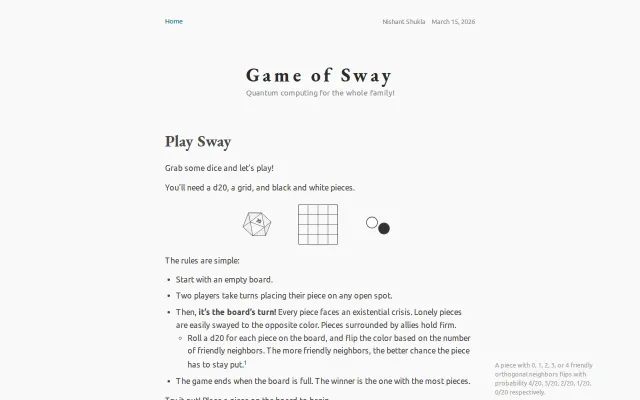
Inverted the usual approach: started with quantum structure, found the game inside it.
Accessibility tree beats screenshot tokens, per-step model control is genuinely clever.
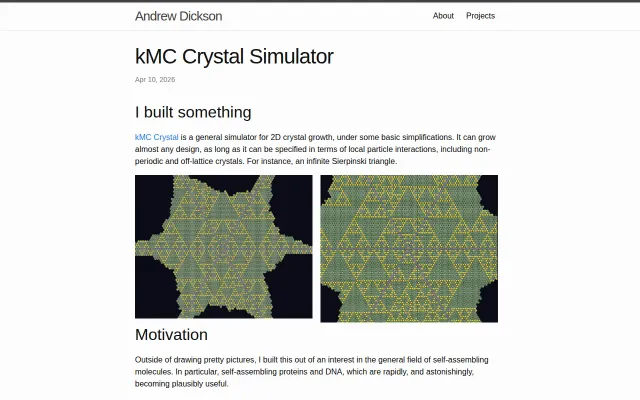
More general than aTAM/kTAM tile models, but the audience is extremely narrow.
The repo actually implements an RK4 geodesic integrator in CUDA kernels to trace millions of rays and produce frame sequences — plus handy scripts to generate a Perlin accretion disk and preprocess NASA EXR star maps. It’s the sort of technical playground that shows real GPU know‑how and produces striking renders, but the experience is experimental: you must manually fetch assets, run preprocessing scripts, and there are no builds, benchmarks or accuracy notes to help anyone reproduce or compare results.