AI/ML●●Solid
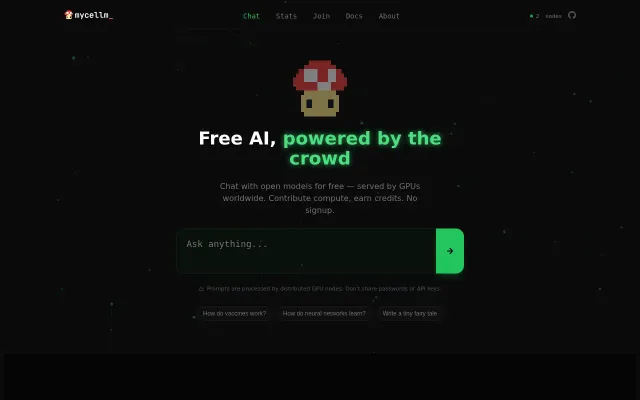
Mycellm – BitTorrent for LLMs, pool GPUs into federated networks
BitTorrent for LLMs with on-device PII scanning before prompts leave your machine.
Bold BetShip ItDark Horse
mijkal
422mo ago

Hardware-aware model bin-packing across mixed GPUs beats manual vLLM config.
ML engineers, self-hosted AI enthusiasts, teams with multiple GPUs
vLLM · Ray Serve · TGI
We built Clusterflock to solve our own headaches with managing AI agents across distributed setups, different VRAM and RAM allowances, and the need to easily try out new models.
While the focus on infrastructure (we built this specifically for networked hardware) it does ship with a powerful mission runner (or orchestrator), which is multi-session and asynchronous.
Here is what it does best:
Hardware-aware auto-downloading: It profiles your networked hardware and automatically pulls down the best models for your specific setup (currently only from HuggingFace).
Tight packing: Native parallelism via llama.cpp, you can allow it to fit multiple smaller models on same device.
It is fully open-source. We wanted a painless way to deploy agentic clusters, and we hope you find it useful too.
Website: https://clusterflock.net
Happy to hear feedback. Flocks very much given.
BitTorrent for LLMs with on-device PII scanning before prompts leave your machine.
Saves neoclouds months of engineering by turning bare metal racks into managed Kubernetes clusters.
Offers a very practical surface — a 2-line @lock("resource_id") decorator plus Redis or file-backed locks and timeout handling to avoid zombie agents. The project pairs that mutex model with a shared blackboard, 12 adapter integrations, and built-in AES-256/HMAC and rate-limiting, so it reads like an orchestration layer rather than just a lock. Impressive test coverage and adapters suggest solid engineering, though I'd want an explicit comparison to existing Redis lock patterns (Redlock) and more distributed-safety docs.
One prompt orchestrates cameras, GPIOs, and screens across five machines via 9P filesystem.
Ray and Prefect alternative claiming single-codebase distribution without the boilerplate.
JEPA orchestration framework solving a real but niche bottleneck—execution.
