AI/ML●●Solid
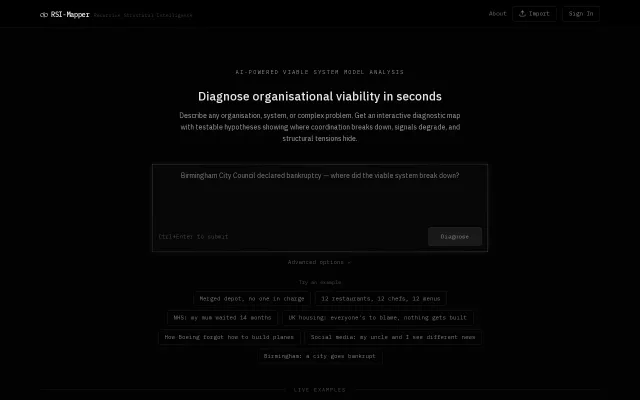
Systems and complex questions into VSM maps and diagnostic hypotheses
Turns vague org complaints into structured Viable System Model diagrams instantly.
Big BrainNiche Gem
rgunther
202mo ago
Fifty-year-old cybernetics theory meets AI for organizational problem mapping.
Team leads, managers, and organizational consultants
Miro · Lucidchart · Systems thinking tools
Built a suite tools that finds structural problems in organisations and systems using the Viable System Model (50 years of organisational cybernetics, made accessible through AI).
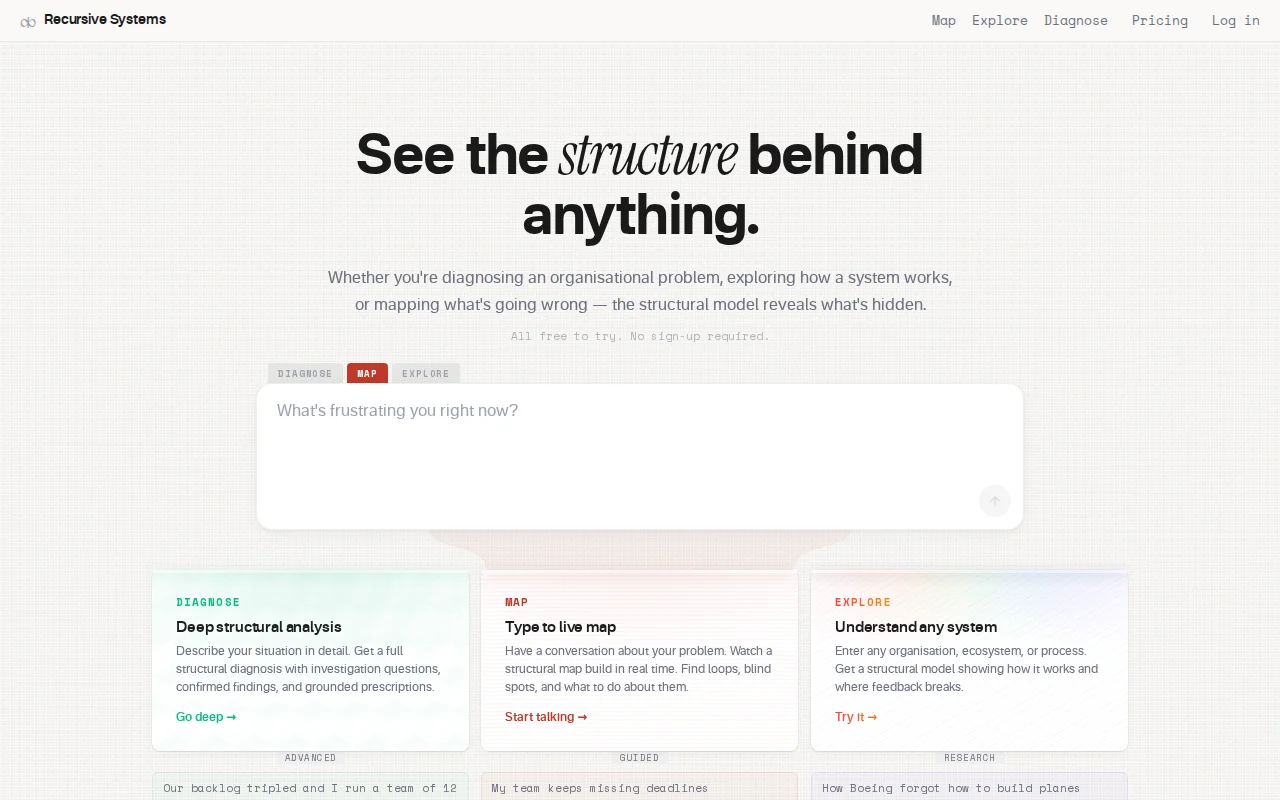
Three modes: Map (new) Describe what’s frustrating you. The tool asks structural questions and builds a visual problem graph in real time. Every node traces back to what you said. It then runs structural analysis, identifies what’s missing, and generates grounded prescriptions.
Explore Type any system and get an instant structural model. Try “How Boeing forgot how to build planes” or “Why do mergers destroy value?” or “The Federal Reserve’s impossible balance.” Good for research and systems thinking.
Diagnose — Describe your situation in detail across three fields. Get a full three-phase diagnosis with investigation questions and prescriptions.
Built solo. Stack is SvelteKit + React, Cytoscape.js for the graph, Supabase Would love feedback, especially from anyone who manages teams or runs a business.
Works best on desktop, on mobile turn landscape to see map.
Turns vague org complaints into structured Viable System Model diagrams instantly.
CMMI extension for SDD migration, but lacks validation data and early adoption proof.
XAI-driven model improvement loop, but Weights & Biases already tracks experiments better.
MCP proxy prevents context-window bloat better than naive LLM forecasting.
Perplexity automation + council synthesis is clever, but loop drivers already exist elsewhere.
Stateful, exposure-aware de-ID over time—novel framing, but repo is research-only with synthetic data.