AI/ML●●Solid
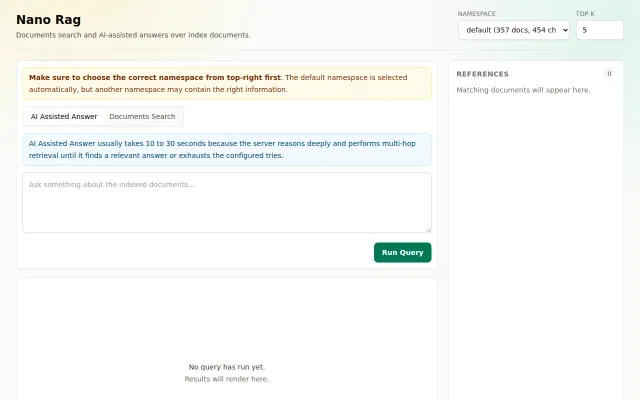
Nano-RAG – Agentic multi-hog retrieval without graph database
SQLite-only RAG with multi-hop retrieval is a clever constraint for a solved problem.
Big Brain
freakynit
2025d ago
Lint for ai generated knowledge
Fact graph construction for AI doc consistency is a genuinely interesting approach.
Teams managing AI-generated documentation, AI system developers
Sourcegraph · Semantic search tools
As AI systems create more task notes, traces, and reports, storing documents isn’t the only challenge.
The real problem is finding the right evidence when the same idea appears in multiple places, often with different wording.
Lint-AI is our current retrieval layer for that problem.
What Lint-AI does currently:
* Indexes large documentation corpora. * Extracts lightweight entities and important terms. * Supports hybrid retrieval using lexical, entity, term, and graph-aware scoring * Returns chunk-level evidence with --llm-context for downstream reviewer / LLM * Use exports doc, chunk, and entity graphs.
Example:
* ./lint-ai /path/to/docs --llm-context "where docs describe the same concept differently" --result-count 8 --simplified
That command does not decide whether documents are in contradiction. It retrieves the most relevant chunks so that a reviewer layer can compare them.
Repo: https://github.com/RooAGI/Lint-AIWe’d appreciate feedback on:
* Retrieval/ranking design for documentation corpora. * How to evaluate evidence retrieval quality for alignment workflows. * What kinds of entity/relationship modeling would actually be useful here?
Visit: https://rooagi.com/
SQLite-only RAG with multi-hop retrieval is a clever constraint for a solved problem.
Curated index for kernel docs when docs.kernel.org already has search and navigation.
Rust CLI chains Podcast Index, Whisper, and YouTube into one command-line workflow.
Agent-optimized CLI design but competes with Cursor and Continue directly.
Scout command with bounded evidence packs beats naive file reads for token efficiency.
Local doc indexing for Claude Code beats context-switching to browser tabs.