Developer Tools●●●Banger
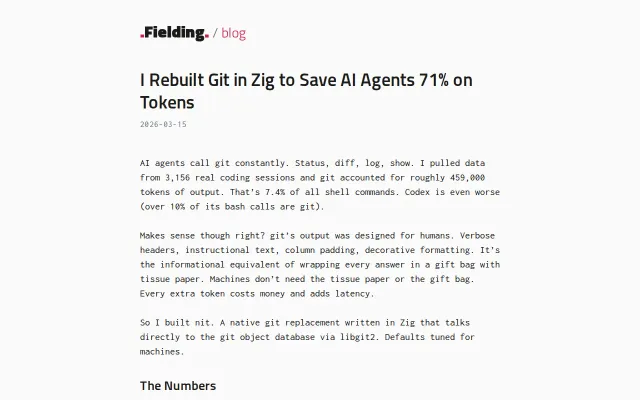
Nit – I rebuilt Git in Zig to save AI agents 71% on tokens
71% token savings on git status by stripping human-readable fluff AI agents don't need.
Big BrainWizardry
fielding
23342mo ago
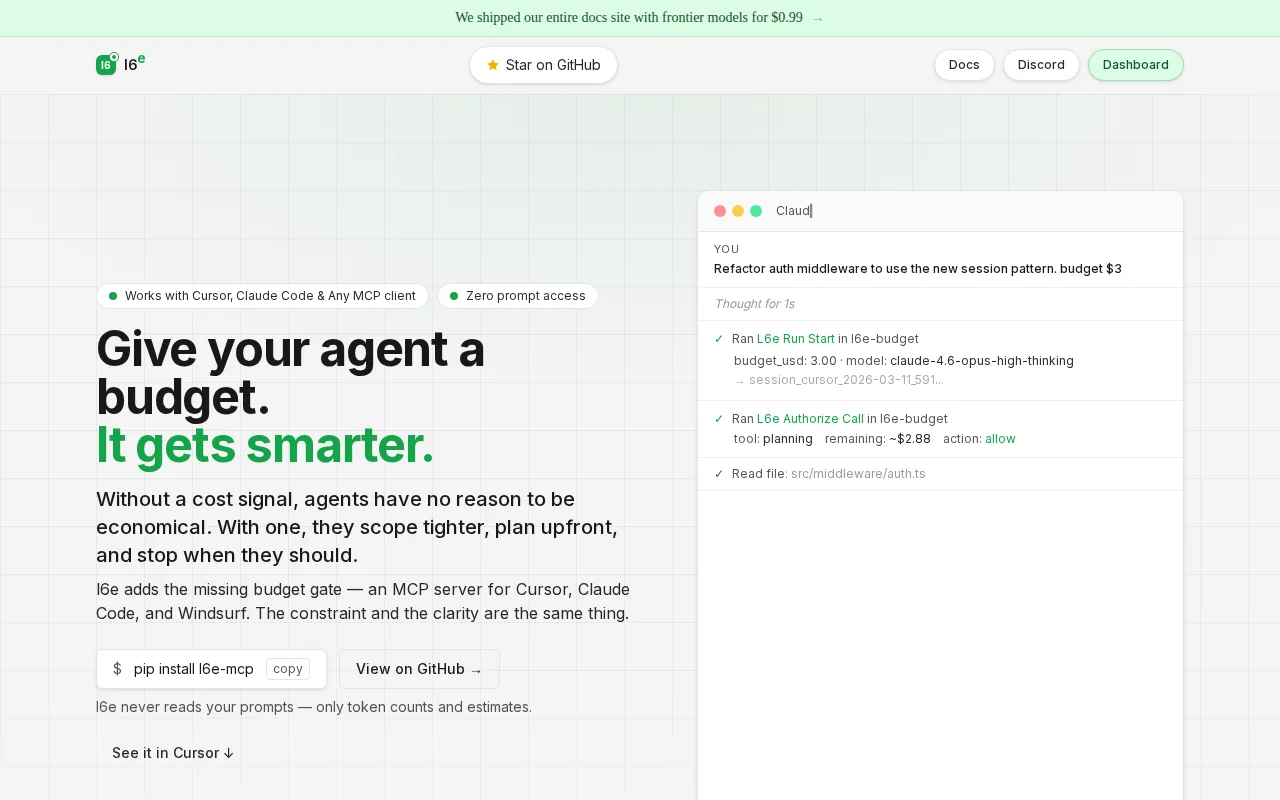
MCP server budgets token spending, making agents plan tighter and stop when done.
Developers using AI coding assistants
Cursor · Claude Code · Windsurf
No. So I built l6e: an MCP server that gives your agent the ability to budget. It works with Cursor, Claude Code, Windsurf, Openclaw, and every MCP-compatible application.
Saving money was why I built it, but what surprised me was that the process of budgeting changed the agent's behavior. An agent that understands the limitations of the resources doesn't try to speculatively increase the context window with extra files. It doesn't try to reach every possible API. The agent plans ahead, sticks to it, and ends work when it should.
It works, and we've been dogfooding it hard. After v1 shipped, the rest of l6e was all built with it. We launched the entire docs site using frontier models for $0.99. The kicker was every time l6e broke in development, I could feel the pain. The agent got sloppy, burned through context, and output quality dropped right along with it.
Install: pip install l6e-mcp
Docs: https://docs.l6e.ai
GitHub: https://github.com/l6e-ai/l6e-mcp
Website: https://l6e.ai
Optional cloud: https://app.l6e.ai
Happy to answer questions about the system design, calibration models, or why I can't go back to coding without it.
71% token savings on git status by stripping human-readable fluff AI agents don't need.
Tracks tokens not dollars—clever design that avoids pricing drift headaches.
Local indexer with AST + impact graph replaces grepping and cloud RAG for code context.
Stops AI agents burning tokens on empty polls, unlike standard heartbeat loops.
Another agent orchestration framework competing with Langflow, n8n, and ComfyUI.
Macaroon-based budget enforcement for AI agents—fills a real economic governance gap.