AI/ML●Mid
Real-time violent action detection using computer vision
Standard YOLO + LSTM pipeline for violence detection, nothing novel beyond the specific use case.
Bold Bet
iraton
214mo ago

OpenCV-based detection without ML models, but accuracy unproven against Hive or Illuminarty.
Content moderators, artists, and developers building AI agents
Hive Moderation · Illuminarty · Sightengine
The detection runs on a separate FastAPI backend using pure OpenCV — no ML model, no GPU, just classical computer vision techniques looking for the artifacts diffusion models leave behind. The Next.js app handles auth, billing (Dodo Payments), and proxies images as raw binary to keep latency low. Async polling on the frontend.
Inspiration came from r/isthisai — people there spend a lot of energy arguing whether images are real, and existing detectors are either gated behind enterprise sales or unreliable black-box classifiers. Wanted something a normal person (or an LLM agent) could just hit, and not be data mined. Also purposefully kept an AI model out of the detection due to experimenting with Gemini and noticed it could not even accurately tell me an image that I just had it generate was AI generated.
Background: I was laid off earlier this year and have been building this full-time since Feb 5. Would love feedback on the detection accuracy, or the MCP integration.
Standard YOLO + LSTM pipeline for violence detection, nothing novel beyond the specific use case.
Detects deepfakes locally using optical flow vectors instead of sending files to cloud APIs.
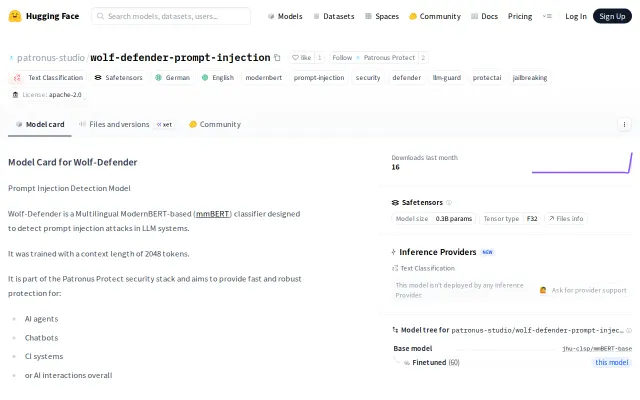
Outperforms existing open-source injection detectors on ProtectAI and Qualifire benchmarks.
Open-vocabulary object detection exporting to YOLO format without login requirements.
Replaces Google Nest's $20/month cloud analysis with local Qwen 35B and a 3D-printed head.
Peer-reviewed LLM hallucination detector using uncertainty quantification, published in JMLR and TMLR.