AI/ML●●●Banger
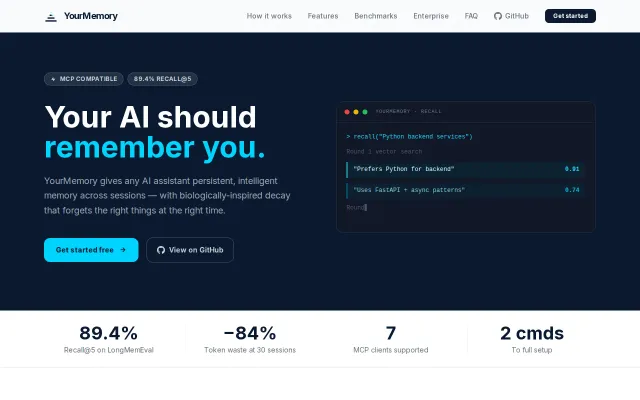
Hippo, biologically inspired memory for AI agents
Biological decay mechanics beat vector search for agent memory that actually forgets.
Big BrainZero to OneNiche Gem
kitfunso
128292mo ago
Agentic AI memory with Ebbinghaus forgetting curve decay. +16pp better recall than Mem0 on LoCoMo.
Ebbinghaus forgetting curve cuts token waste 84% while doubling recall versus Zep.
AI agent developers, LLM application builders
Zep · Mem0 · Letta
This implementation experiments with a biological approach by using the Ebbinghaus forgetting curve to manage context as a living substrate. Memories are assigned a "strength" score where each recall reinforces the data and flattens its decay curve (spaced repetition), while unused data eventually hits a threshold and is pruned.
To solve the "logical neighbor" problem where semantic search misses relevant but non-similar nodes, a graph layer is layered over the vector store. Benchmarked against the LoCoMo dataset, this reached 52% Recall@5, nearly double the accuracy of stateless vector stores, while cutting token waste by roughly 84%.
Built as a local first MCP server using DuckDB, the hypothesis is that for agents handling long-running projects, "what to forget" is just as critical as "what to remember." I'd be interested to hear if others are exploring non-linear decay or similar biological constraints for context management.
Biological decay mechanics beat vector search for agent memory that actually forgets.
ACT-R decay and Hebbian learning as native primitives, not vector hacks.
Local RAG for browser LLMs with decay lifecycle, but already competed by Langchain vectors.
Ebbinghaus decay + offline semantic search beats Mem0, Letta, Memori combined.
Ebbinghaus decay prunes memory automatically, unlike standard RAG hoarding.
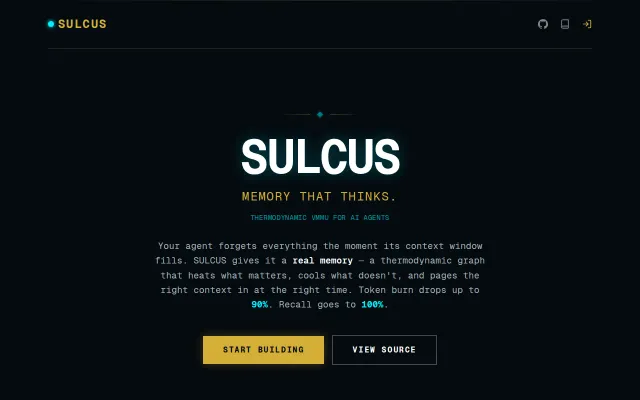
Thermodynamic memory decay beats passive vector search—90% token reduction claimed.