Data●Mid
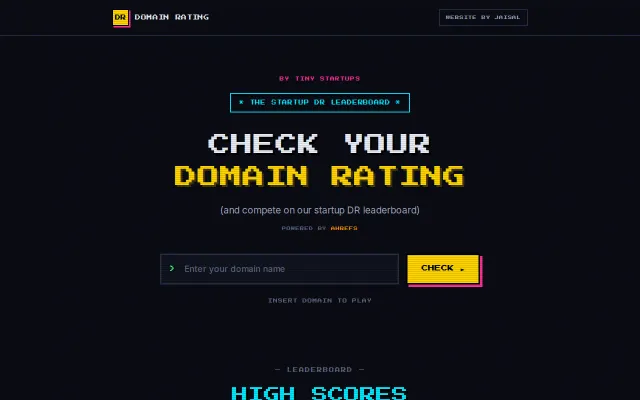
Domain Rating – a leaderboard of startup website Domain Ratings
Ahrefs API wrapped in a retro leaderboard — TrustMRR but for domain rating.
Cozy
nocodeg
304d ago
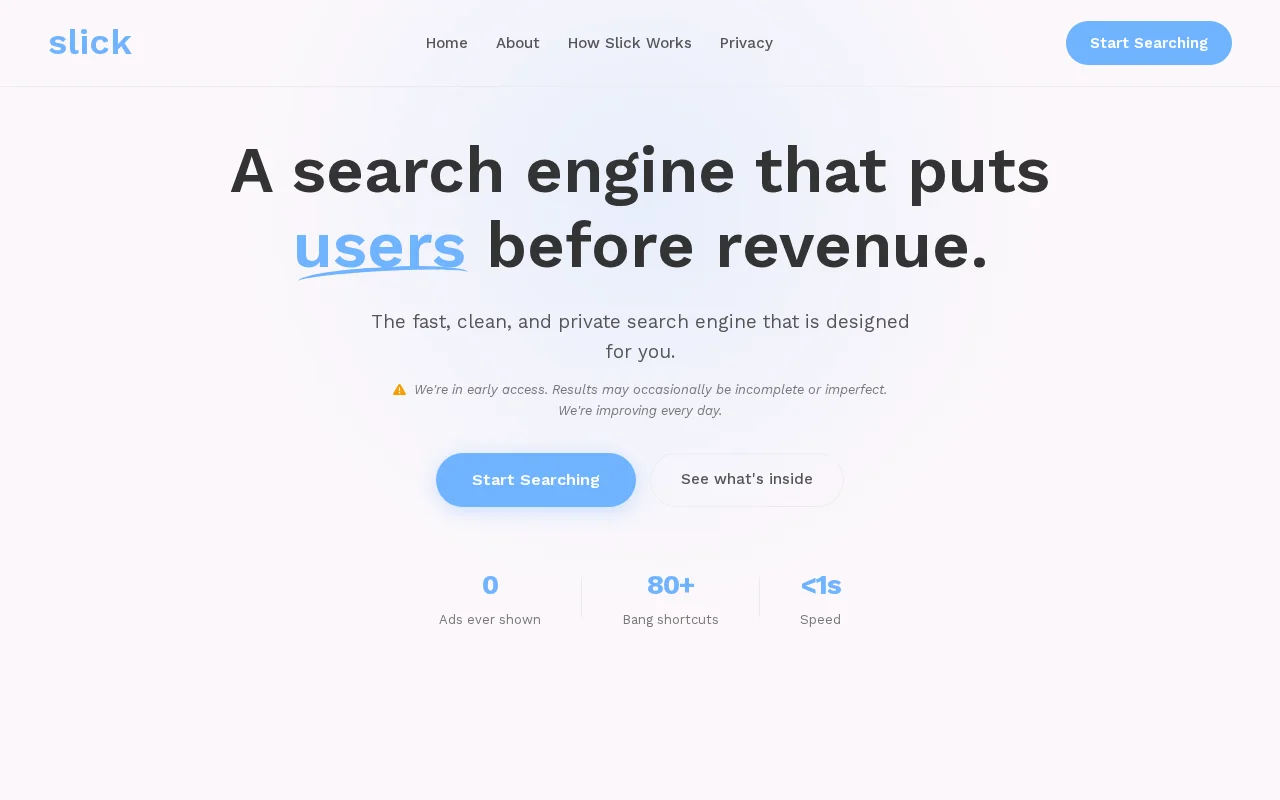
Local per-domain ranking preferences beat Kagi's paid model for privacy purists.
Privacy advocates, Researchers, Power users tired of Google ads
Kagi · Mojeek · DuckDuckGo
What's even worse is that search engines like DuckDuckGo, Startpage, and Ecosia are using AI Overviews too. These features ARE optional, but I still felt annoyed that I had to opt out of everything.
This is why I created my search engine Slick. Slick is an independent search engine with its own index. It aims to be everything users want from a search engine, whether that's privacy, speed, transparency, or customization.
We aim to let users have full control over their search engine. Currently, we have implemented this using custom per-domain ranking (similar to Kagi) and custom bangs (DuckDuckGo bangs, but faster and with the ability to add your own).
For revenue, we WILL be using ads in the future, but we want to approach them differently. The ads are intentionally made very visible (bright yellow text, bigger font, etc) instead of using a tiny "sponsored" label. Ads will only be visible on the first page, and there is a maximum of 1 ad per page instead of Google's 1-4.
We are also experimenting with keeping the ads in the actual search results, and I would really like your feedback on this. Since the ads are very visible, instead of forcing them to the very top, we rank them similarly to normal results (with a slight boost so they stay on the first page). The idea is that if an ad is shown, it should at least already be relevant to your query.
Now I'm not going to make the mistake of claiming "privacy" like I did in my Reddit post. Not because Slick isn't private, but because it's not open source and users currently have no way to verify what we say. We want users to feel safe when searching, which is why we want to eventually invest into audits regularly once the project is in a more stable position.
I've only been listing good things about Slick so far, so now it's time for the issues Slick is currently facing for full transparency.
Slick's major issues right now are result quality and speed. When I say bad result quality, I don't mean bad ranking. I've made a detailed overview of Slick's ranking in our blog pasted below. The issue mainly comes from our small index. Since we're a completely independent search engine, we have to do all of the crawling ourselves. Our web index is currently only around 2.5 million documents, although it is slowly growing.
The second issue is speed. This is something we are actively working to fix, but we are heavily limited by infrastructure. Slick isn't running on a massive server, or even a good PC. We are currently running on a Beelink EQR5, which is suboptimal (suboptimal may be an understatement).
These are only the issues I've personally noticed so far, but there are probably many more.
I posted Slick on Reddit a while back, but I didn't get exactly what I was hoping for. A lot of people told me that if the search engine was truly private, they would need the source code. That's part of why I've decided not to lean too heavily into privacy claims on this HN post.
I would really like your ideas, critiques, bug reports, and feedback on Slick. We hope you can support our endeavour to build a search engine that puts users first.
Blog: https://blog.slicksearchhq.com
Search Engine: https://slicksearchhq.com
Ahrefs API wrapped in a retro leaderboard — TrustMRR but for domain rating.
TrueSkill beats ELO by modeling uncertainty, cuts O(N²) comparisons to O(N) with sequential elimination.
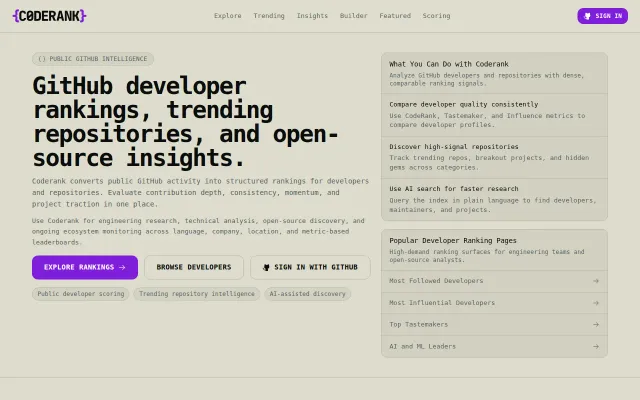
Tastemaker metric identifies trendsetters before projects go mainstream, rewarding early adoption.
Yet another name checker when Namechk and KnowEm already dominate this space.
FM-index implementation delivers 1.5ms exact matches where grep chokes on scale.
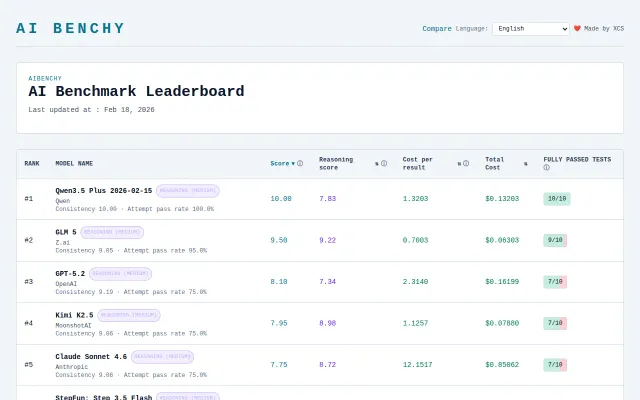
The reasoning-score idea — a separate LLM judging chain-of-thought efficiency and penalizing token-churn or looping — is the clearest clever move here, and pairing that with cost-per-result and consistency metrics makes the leaderboard actually useful for product decisions. The table UI is clean and immediate, but the project needs more transparency on test corpora, judge prompts, and reproducibility before I’d trust swaps in production.