Developer Tools●●Solid
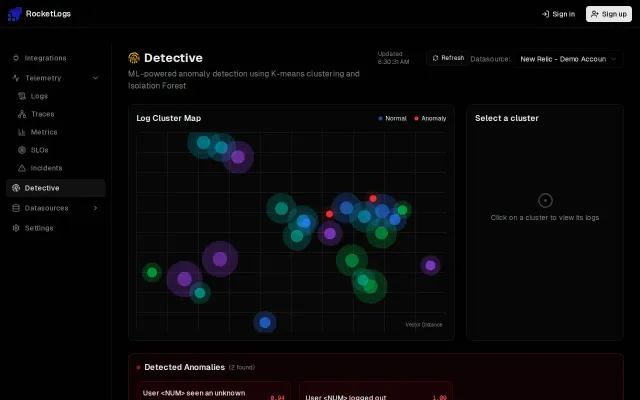
Using Isolation forests to flag anomalies in log patterns
Isolation Forest + K-means clustering detects log anomalies visually, but Datadog and Splunk already ship this.
Solve My ProblemBig Brain
kvaranasi_
413mo ago
ML-powered QA framework for EV battery systems — telemetry validation, anomaly detection, SOH prediction, CAN bus (2.0B + J1939) emulation, DBC parser, Prometheus metrics, Grafana dashboard
Standard ML pipeline (Isolation Forest + LSTM) applied to battery telemetry without novel architecture.
EV battery researchers, automotive QA engineers, battery data analysts
Battery Analytics platforms · Automotive telemetry tools
Isolation Forest + K-means clustering detects log anomalies visually, but Datadog and Splunk already ship this.
Isolation Forest + a Recovery Engine that can manage Docker containers is the clearest, worthwhile idea here; structured JSON logs and pytest hints at attention to auditability and QA. The repo, however, reads like an ambitious prototype — few commits, placeholder clone URLs, and README rhetoric (EB-2 NIW mentions) outpaces the visible implementation — promising, but still early and derivative in a crowded auto-heal space.
Purpose-built CAN intrusion detection; unsupervised learning detects zero-day attacks without labeled data.
Maptoposter fork for electrical grids—nice visuals, but derivative by design.
Native Python competing-risks RSF that's 6x faster than R's randomForestSrc.
The repo stakes a clear, focused claim: automated asset-level mapping between AESO grid telemetry and TSX tickers, plus live tracking of 'capture price' vs pool price and a 2026 TIER margin model — ideas that actually matter for energy quant work. It’s an ambitious bridge between high-frequency grid signals and SOTP equity layers, but the README and repo structure suggest an early-stage implementation: useful scaffolding and tests exist, yet I want to see example outputs, backtests, and the concrete linkage from unit-level revenue to corporate P&L before buying the institutional-advantage claim.