AI/ML●Mid
SynapseKit – Async-native Python framework for LLM pipelines and agents
LangChain alternative with 2 dependencies in an already crowded framework space.
Ship It
aminau
422mo ago
An intent-based language for agentic systems. Write agents in English. Transpile to async Python.
Transpiles English-like agent DSL to Python with confidence-gated branching and budget controls.
Developers building LLM agent workflows
LangGraph · CrewAI · AutoGen
LangChain alternative with 2 dependencies in an already crowded framework space.
AgentForge compresses common production patterns—token-aware rate limiting (token-bucket), retry+exponential backoff, prompt templates and cost tracking—into a tiny async core and lets you flip providers with one parameter. The multi-agent mesh and ReAct loop bits are the most interesting engineering bets here, and the repo includes benchmarks and a Streamlit demo, but it lives in a crowded space next to LangChain and similar toolkits so real differentiation will come from adoption and edge-case robustness.
Behavior-tree orchestration for agents when LangGraph and AutoGen already exist.
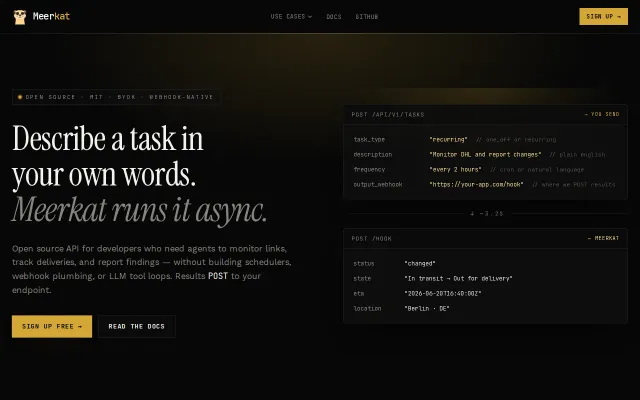
Collapses schedulers, LLM loops, and webhook plumbing into one register verb.
AgentForge packs provider adapters (Claude, GPT‑4, Gemini, Perplexity), token-aware rate limiting, retry/backoff, and a MockLLMClient for tests into a tiny dependency surface — the 15KB footprint and 2 dependencies is an attention-grabber. The 3‑tier Redis cache and benchmark claims (huge latency/memory wins vs LangChain, 88% cache hit) make it a tempting low-overhead alternative, though you should validate provider feature parity and benchmarks against your workload.
Agents write Python to analyze traces; 2x improvement on τ2-bench, but narrow evaluation scope.