AI/ML●Mid
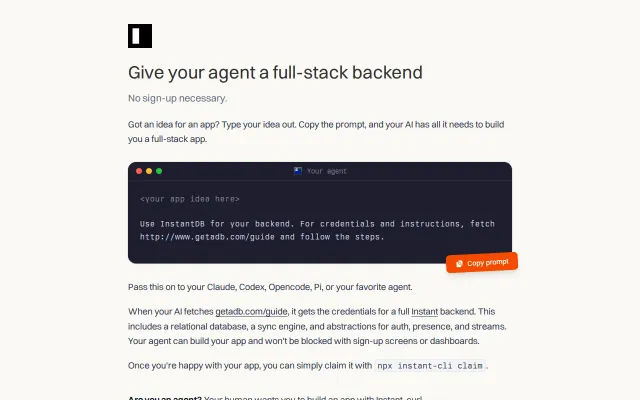
GETadb.com – every GET request creates a DB
Clever prompt injection for agents, but humans still need to run the CLI to claim ownership.
Bold Bet
nezaj
39442mo ago
Run GLM-5.2 (744B MoE) on a 25GB-RAM consumer machine — pure C, zero deps, experts streamed from disk. Tiny engine, immense model. 🐦
Streams 744B MoE experts from disk to run on 25GB RAM—no GPU, pure C.
ML engineers, hobbyists running local LLMs, constraint-focused developers
llama.cpp · MLX · Ollama
The dense part (attention, shared experts, embeddings—~17B params) stays resident in RAM at int4 (~9.9 GB); The 21,504 routed experts (75 MoE layers × 256 experts + the MTP head, ~19 MB each at int4) live on disk (~370 GB) and are streamed on demand, with a per-layer LRU cache, an optional pinned hot-store, and the OS page cache as a free L2.
The engine is a single C file (c/glm.c, ~1,300 lines) plus small headers. No BLAS, no Python at runtime, no GPU.
No GPU or serious hardware because I don't have that hardware so I can't test it on hardware that is more powerful than my computer.
Colibrì is a one-person project, written and tested entirely on a 12-core laptop with 25 GB of RAM — the numbers above are the ceiling of what I can measure at home. If this project is useful or interesting to you and you'd like to support its development (better hardware test translates directly into a faster engine for everyone: real NVMe scaling data, bigger pinned caches, int2/int3 quality sweeps on real benchmarks), you can:
star the repo and share it; open issues with benchmark numbers from your hardware; reach out via GitHub issues if you'd like to sponsor development or donate hardware.
Every contribution, from a datapoint to a disk, moves the ceiling.
Any feedback are welcome!
Repo: https://github.com/JustVugg/colibri
Clever prompt injection for agents, but humans still need to run the CLI to claim ownership.
Full network stack in 8 kB of Go on a Pico—genuinely constrainted yet functional hardware hack.
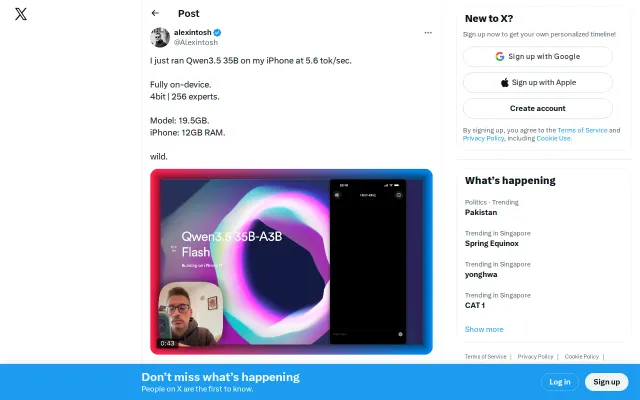
Runs 19.5GB Qwen3.5 on 12GB RAM iPhone via memory swapping.
Native Swift DI.FM client at 35 MB beats 200+ MB Electron, but requires paid DI.FM membership.
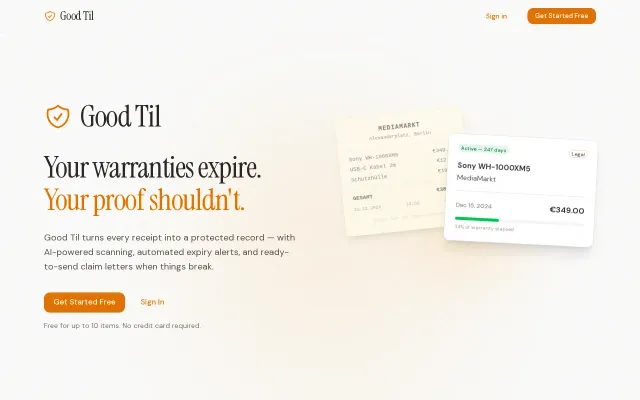
AI receipt scanning + auto-generated warranty claim letters citing local law—solves real consumer friction.
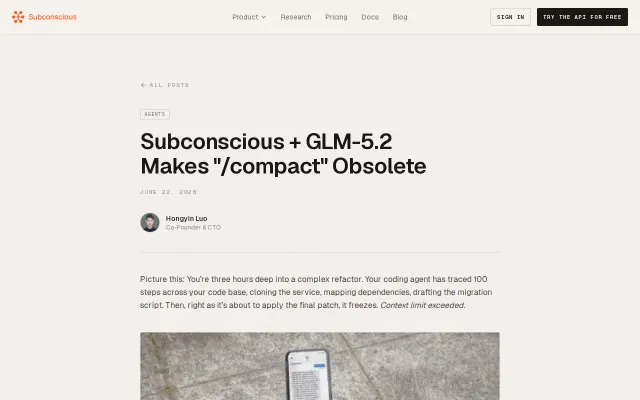
Another context management pitch when Cursor and Continue already solve this.