Hardware●●●Banger
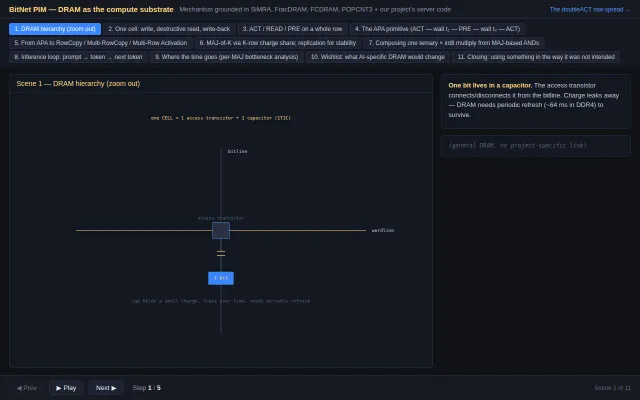
Running BitNet b1.58 inside DRAM by breaking DDR4 timing rules
Running AI inference by breaking DDR4 timing rules on off-the-shelf memory is wild.
WizardryBig BrainRabbit Hole
pcdeni
602mo ago
Software side of an LLM running inside a DRAM chip via charge-sharing PIM (BitNet b1.58 on DRAM-Bender silicon).
Running matrix multiplies inside DRAM cells via charge-sharing defies standard memory architecture.
Hardware researchers, systems engineers, and ML infrastructure experts
UPMEM PIM · Samsung AiM · Mythic AI
Moving AI on-device is a brilliant and necessary strategy. It ensures absolute user privacy in alignment with EU regulations, fundamentally shifts the economics away from costly cloud inference, and paves the way for a significant hardware upgrade supercycle as users seek true AI-capable silicon.
To create a smart on-device "Semantic Router," models need to reach the 27B+ parameter scale. Achieving this on a phone requires extreme quantization, such as PrismML’s ternary weights.
However, a critical hardware reality often overlooked by the software world is that fitting the weights in RAM is not equivalent to moving them. Running a 27B ternary model on standard LPDDR encounters a significant memory bandwidth limitation. Transferring gigabytes of data across the SoC bus for each token generation can lead to thermal throttling of the NPU and excessive battery drain.
This raises an important question: why are we still transferring data to the compute? Why not execute AI inference natively within the memory?
Frustrated with academic PIM simulations that overlook bare-metal physics, I developed CaSA, an architecture that performs ternary LLM inference directly inside COTS DRAM through charge-sharing, completely bypassing the memory bus.
Software quantization is a great initial step, and CaSA provides the physical hardware substrate needed to complete the bridge: https://github.com/pcdeni/CaSA
Running AI inference by breaking DDR4 timing rules on off-the-shelf memory is wild.
Runs completely offline with llamafile but LLMs make unreliable Catan negotiation partners.
Another Pomodoro timer, but this one forces you to stop working.
Wake-anchored timing means breaks never interrupt your flow state.
Flexible phase switching is nice, but dozens of Pomodoro apps already do this.
Fills the TypeScript gap that Semgrep's official AI best practices pack misses.