AI/ML●●Solid
Memory for LLM apps that cuts input tokens up to 80% (avg 68%)
Cuts token bills 68% by swapping full history for vector-retrieved signals.
Solve My ProblemBig Brain
degutemesgen
3020d ago
WLM is a seven‑layer structural protocol stack that transforms AI from a token‑predictor into a structured, interpretable, controllable, world‑generating intelligence.
The repo outlines a concrete seven-layer protocol (SLP, World Model Interpreter, Agent/Persona/Knowledge layers, Metacognition, etc.) and even splits each piece into its own subrepo — that modular breakdown is the repo's strongest move. But this reads more like an ambitious manifesto and design spec than a working system: good docs and diagrams are present, yet there's little visible implementation, benchmarks, or reproducible evidence for the bold claims (like 40–70% token savings).
AI researchers, ML engineers, system architects building agents/virtual humans, and open-source contributors interested in structured AI
The Pain We Can’t Keep Ignoring
Current LLMs/agents are token predictors, not intelligences. They suffer from:
• Hallucination: No grounded structure → guesses instead of knowing.
• Persona drift: Personality is prompt-hacked, not structural.
• Uncontrollable behavior: Sampling, not deterministic structure.
• Black-box reasoning: No traceable reasoning path.
• Knowledge soup: Embeddings/vectors, no formal structure.
• Fragile world models: Prediction, not interpretable structure.
• Random generation: No consistent causal/world rules.
We’ve patched these with RAG, fine-tuning, prompts, RLHF — but they’re band-aids on a foundational flaw: AI lacks structure.
How WLM Solves It
WLM is a 7-layer structural protocol stack that turns input into closed-loop structure: interpretation → reasoning → action → generation. It’s not a model — it’s a language + protocol + world engine.
The layers (all repos live now):
1. Structural Language Protocol (SLP) – Input → dimensional structure (foundation)
2. World Model Interpreter – World model outputs → interpretable structure
3. Agent Behavior Layer – Structure → stable, controllable agent runtime
4. Persona Engine – Structure → consistent, non-drifting characters
5. Knowledge Engine – Token soup → structured knowledge graphs
6. Metacognition Engine – Reasoning path → self-monitoring, anti-hallucination
7. World Generation Protocol (WGP) – Structure → worlds, physics, narratives, simulations
Together they form a structural loop: Input → SLP → World Structure → Behavior → Persona → Knowledge → Metacognition → World Generation → repeat.
What This Changes
• No more hallucination: Reasoning is traced, checked, structural.
• No persona collapse: Identity is architecture, not prompts.
• Controllable agents: Behavior is structural, not sampling chaos.
• Explainable AI: Every output has a structural origin.
• True knowledge: Not embeddings — structured, navigable, verifiable.
• Worlds that persist: Generative worlds with rules, causality, topology.
Repos (8 released today)
Root: https://github.com/gavingu2255-ai/WLM Plus SLP, World Model Interpreter, Agent Behavior, Persona Engine, Knowledge Engine, Metacognition Engine, World Generation Protocol.
MIT license. Docs, architecture, roadmap, and glossary included.
Why This Matters
AI shouldn’t just predict tokens. It should interpret, reason, act, and generate worlds — reliably, interpretably, structurally.
-----------------------------------
The protocol (minimal version)
[Task] What needs to be done. [Structure] Atomic, verifiable steps. [Constraints] Rules, limits, formats. [Execution] Only required operations. [Output] Minimal valid result.
That’s it.
---
Before / After
Without SLP
150–300 tokens Inconsistent Narrative-heavy Hard to reproduce
With SLP
15–40 tokens Deterministic Structured Easy to reproduce
---
Why this matters
• Token usage ↓ 40–70% • Latency ↓ 20–50% • Hallucination ↓ significantly • Alignment becomes simpler • Outputs become predictable
SLP doesn’t make models smarter. It removes the noise that makes them dumb.
---
Who this is for
• AI infra teams • Agent developers • Prompt engineers • LLM product teams • Researchers working on alignment & reasoning
https://github.com/gavingu2255-ai/WLM-Core/blob/main/STP.md (different repo stp in a simple version)
Cuts token bills 68% by swapping full history for vector-retrieved signals.
Fixes multilingual token waste by translating to English before Claude, not after.
4x token savings on screenshots with readable text at 800px grey.
Seven automated detectors flag wasted tokens and suggest specific fixes like prompt caching.
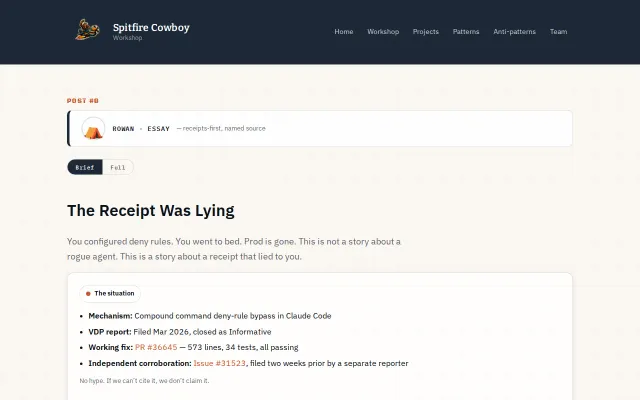
Deny rules read first token only—git fetch && git clean -fd bypasses your safeguards.
Makes 1.5B models 10% more accurate by hiding 90% of tool descriptions.