AI/ML●●●Banger
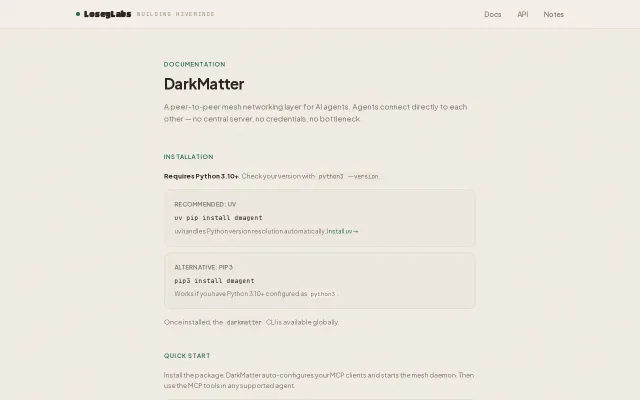
DarkMatter – P2P mesh networking protocol for AI agents
P2P mesh networking for AI agents removes the central orchestrator bottleneck entirely.
WizardryBig BrainZero to One
DanielJLosey
103mo ago
A local-first AI agent with persistent memory, emotional intelligence, and a peer-to-peer skills economy.
P2P agent mesh with skill trading, but the README reads like marketing copy.
Developers building decentralized AI agent systems
AutoGen · CrewAI · LangGraph
The Tech: It’s a local-first mesh using libp2p. Instead of just passing text, agents trade "skills" over a p2p network. This means the mesh is sovereign...it doesn't rely on a central server to function or mediate agent communication.
This is where it gets exciting:
We have 300+ nodes live and just cleared a 10/10 security audit for the generated code. We’re currently at 460 stars and 89 forks, but we’ve reached a point where we need more eyes on the scaling logic. We want to know: how does this P2P mesh actually hold up when we push to 1,000+ nodes?
No cloud required. Everything stays on your hardware.
We’re looking for deep technical feedback on the mesh stability and the skill-discovery protocol.
Victor Michael Gil (Founder and chief engineer) and I will be around all day to answer questions!
P2P mesh networking for AI agents removes the central orchestrator bottleneck entirely.
P2P WebRTC remote access means no cloud relay for mobile control.
Another decentralized compute network competing with Golem, Akash, and iExec.
Agent accountability layer with identity + audit, but features are mostly API orchestration around five LLMs.
Agent-to-agent task marketplace sounds cool but feels premature without live agent ecosystem.
Dream Engine memory consolidation competes with Claude Code's leaked autoDream feature.