Infrastructure●●●Banger
Open-source logic synthesis – formal logic to FPGA
Open-source logic synthesis running on FPGAs when Yosys dominates the space.
Zero to OneWizardryBold Bet
major4x
103mo ago
Idiomatic Python to Verilog without decorators when Polyphony and Veriloggen already exist.
FPGA developers, embedded systems engineers, control systems/DSP engineers
Polyphony · Veriloggen · MyHDL
So, behold Holoso: https://github.com/Zubax/holoso
To me personally this is a big deal because it has already enabled dramatic acceleration of my work. The feature set is currently mostly defined by my immediate needs but it is extensible and contributions are welcome.
I will spare a detailed explanation of how it works (follow the link for that) but the basic idea is that it parses Python, constructs a CFG, identifies which operators are needed, constructs a minimal specialized VLIW core, schedules microcode (fully statically to keep the core simple), and emits Verilog along with some extra outputs like Cocotb and reports. There are examples included that will give you a better feel of what it's like; there are even some exotic ones like UART rx/tx, which I would not call a sensible use of this tool but it's mostly there to outline its limits more clearly -- it's an HLS, not an RTL, so keep that in mind.
I have already benchmarked it side by side with Bambu, XLS, Dynamatic, and Vitis, and the results seem decent; I am going to post about this later if there's interest (still working on this).
Holoso is available under Apache-2 with explicit legal waivers for generated RTL.
Hopefully someone will find it useful as well!
Open-source logic synthesis running on FPGAs when Yosys dominates the space.
Claims AI agents design 7nm GPUs end-to-end, but the June 2026 README reads more like speculation than shipping code.
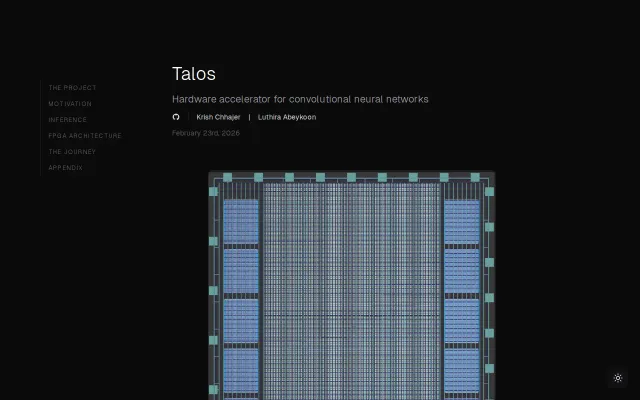
Strips away PyTorch flexibility entirely; full CNN inference as deterministic hardware logic in SystemVerilog.
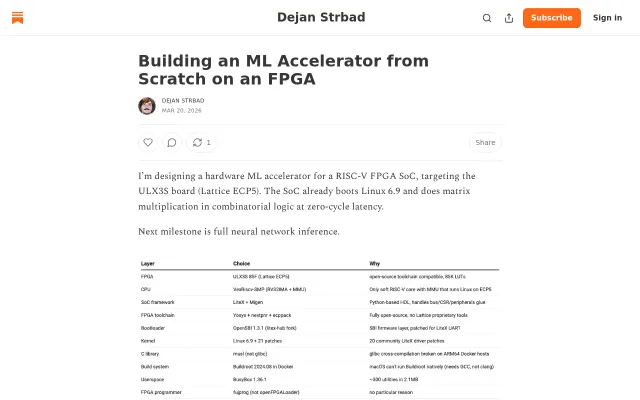
Zero-cycle matrix multiplication in combinatorial logic on Lattice ECP5 is genuinely wild.
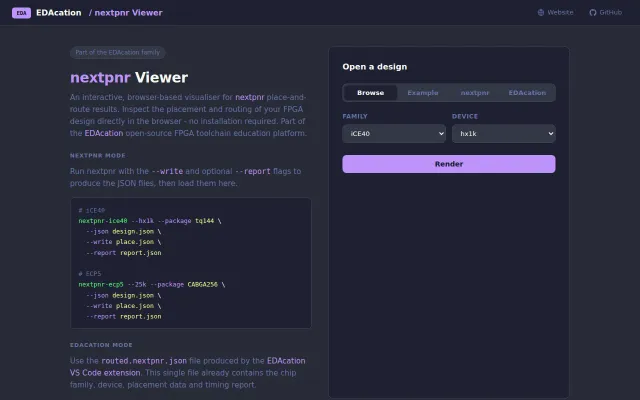
Rust-to-WebAssembly FPGA renderer running entirely in-browser with zero installation.
24-trit balanced ternary RISC processor on FPGA is hardware wizardry.